Sunday, September 03, 2006

The difficulties and dangers of mine rescue work on the western front

This is a link to a gung- ho article about tunneler's in the first World War,

-The Difficulties And Dangers Of Mine-rescue Work On The Western Front byLieut.-Colonel D. Dale Logan, d.s.o., m.d., d.p.h.

at the site of the Northern England institute of mechanical engineers, which, has some interesting papers on line. Miners were used as tunnellers in both wars(you tunnel underneath something to blow it up, flood it etc- so on top of the dangers of tunneling without industrial safety standards, the enemy would gas any tunneling operations they identified.

I had not known that tunnelers were over 40, I guess if you were young you went to the trenches. So it would be unlikely that any Snowdon miners were ex tunnelers and is I need to rework my plot-


Thursday, August 31, 2006

Imminent Heat Stroke in the Inferno

From Harknell, I have figures for heat and humidity in Snowdon pit back in the day (100˚F at the face (38C) humidity 80˚)

I wanted to know what these figure might mean in terms of health so-

Using this Humidex rating scrumped from the Canadian Occupational Health Resource to plotted Snowdon conditions on the graph (represented with a star). Results in a Humidex reading of 58- in the red ‘imminent heat stroke’ zone.

This graph doesn’t take account of the poor ventilation and amount of dust in ‘the Inferno’

So how did men fare under those conditions?

Mr McEwan quoted by Harknell: ‘ There was a fella tramped from Durham, took him seven days to get here, and he got his job on the Monday night, he sat down at 2-o-clock and said” I do feel bad”, and the next thing he just keeled over-dead as doornails’

Others got out in time:

‘The heat was so tremendous that he couldn’t stick it. He came, signed on, so pleased he’d got a job and then- he disappeared.’

And some that were flagging were pushed out in time:

‘Some of them couldn’t work, they were too weak. They were in such bad stress after walking down. They eventually got the sack, they’d have a note on their lamp and they’d have to see the manager. He’d stand them off and then they’d walk back. It was terrible. They didn’t have much help of us either. It was dog eat dog. You didn’t have the money.’

You had to be under forty, in good health, and to have worked recently to have a chance at Snowdon- The point is Snowdon conditions were just at the limit of human tolerance-

Tuesday, August 29, 2006

The Migration of Mining Families to the Kent Coalfield between the Wars, comes to Belgium

Today was a very special day because Volume 6, Number 1 of the journal of the Oral History Society , 1978, the one with the article -

The Migration of Mining Families to the Kent Coalfield between the Wars, by Gina Harkell.

Thumped and struggled thru the letter box

‘Each to his own, ‘ my husband said, off my joy.

I sent my cheque this time last year.
After three months I e-mailed to ask what had happened to my journal?

No reply and my hopes slowly seeped away. But I was too hasty – possibly,the postman had walked it to Belgium, taking odd jobs on the way.

I cant publish it here, copyright . But I have listed names of miners and wives quoted - if you are looking for ancestors check the list linked here, and if that’s not enough information -e-mail me and I’ll send you the relevant quote. Then you’ll know if the journal is worth the 25 pound and 12 month waiting list!

Conditions in the pit( miners early this century made a distinction between a pit which could only be reached by a shaft, and a mine that could be walked into,by their lights Snowdon was a pit not a mine - my blog is misnamed) and the dissatisfaction in Aylesham in those early years were worse even then I thought- but that’s for another post.

Beachcombing for Mine Equipment?


Last week we walked along beautiful beaches from Cove to North of Berwickin Scotland, sand rippled with coal dust,and piled with driftwood and bones of gannets from the great gannetry of bass rock.

(Many were dark feathered – flightless fledglings who plunge into the sea and have a dangerous swim of it for the first two weeks of their migration)

But also rusting machinery – one looked like an airplane undercarriage; another had four wheels still connected on an axle, perhaps from a narrow gauge train?

That l liked and wanted to take home to grow pinks and sea holly around it (but practically difficult with the rust and moving parts). It was only when we stopped at the National coal mining museum near Barnsley on the way back to Hull ferry that I could identify these machines as the bones of abandoned coal mines, the set of wheels I fancied was from a truck that carries the coal up out of the mines.

I tried to find out more but I found only this excellent essay, A Sense of time in the Fife Coalfields on the sea and the abandoned mines of Fife a little further north. It’s also the funniest geology essay I’ve read, thru admittedly possibly the only geology essay I’ve read.

The Author tells of the collapse of land and beach in Fife as the land settles and shifts into its abandoned mines, of signs reading ’ beware road subsiding ‘- of a mine closed in 1972, but still being pumped to prevent flooding of the surrounding land.

He says ‘trash rock that came out of the active mine was dumped straight onto the coast.’

All along the beaches too you could see lumps of old brick structures deposited, presumably from the coalmines, and forming part of the sea defences now. An old lime kiln stood just down from the cement works.

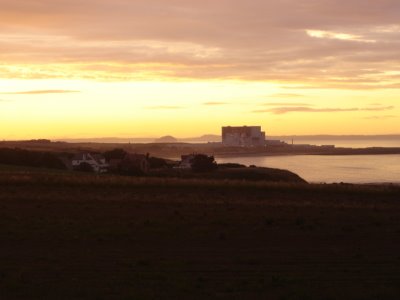
I carelessly, thought to take no pictures of the jetsam, so this is Tourness nuclear power station, always in sight, wherever we walked.

Thursday, August 10, 2006

Mine Closed for Holidays until August 24th

Bandy legged Dog and Spotty Dog do the Egg and Spoon Race

Here’s another vivid piece of twenties life from the same page in the Dover Express as the Boy who caught Fire-

Not a lot to say about this, except that communities really knew how to make their own entertainment in the good old days-

But note that althrough the charming prize categories in the Dog Show are remarkably democratic - open to every village child and mongrel- only two winner’s owners get their names in the paper, Mrs Barlow of Eythorne House, Eythorne and Mr D. McCall Smith, and they are surely gentry -

Great Mongeham

DOG SHOW- On Saturday a dog show organised by Miss Wickham and the Hon. Mrs. Walter James, took place in the local Nursing Association. Prizes were given for the longest dog, and the dog with the longest tail, the most bandy –legged dog; the dog with the most spots, the biggest and the smallest dogs, and the one with the most sympathetic eyes. There was also a tortoise race, a three legged race, an egg and spoon race (with dog attached), also a dog race with owners attached. All created the utmost amusement for a large crowd of spectators. The programme concluded with an amusing parade of dogs in Fancy Dress. The judges were Sir Reginald Tower, Lord Northbourne and Mrs. S. Spanton. The championship prize was won by a Red Setter belonging to Mrs. F. Barlow, of Eythorne House, Eythorne, and that for the smallest dog by Mr. D. McCall Smith of Ash, with an 18 months old Pekinese ‘Old Bill’, weighing just over three pounds. The prize for the ugliest dog was awarded to a Dalmatian.

Boys who Catch Fire

I have returned to the Misery Farm story, picking up speed to about 2 pages a year, I’ll be finished in oh, four hundred years.

I am constantly distracted by, eg, the photocopies I took of relevant articles in the Dover Express and East Kent News, but it’s the little items tucked away on the same page that mesmerize


Here’s one

Dover Express and East Kent News, Friday 16th August 1928

SHEPERDSWELL-

VICARS PROGRESS- We are pleased to announce that the REV. E.C. Robinson is progressing favourably after being burnt on the hands in helping a boy who had caught fire on Wednesday last week. His duties at the church on Sunday last were carried carried out by the Rev P Wilson, who will also conduct the services on Sunday next,


And I can’t stop thinking about this- (of course I found out when I started researching this story last year that accidents illness and death rate in kent in the 1920s were heartbreaking, the accident rate in Snowdon mine itself makes a tour of duty in Iraq look pretty attractive, but on top of that people are dying of infections in the hospital, of a lack of waryness of motorized vehicles, all sorts )

However this newsbite's tone suggests that a boy catching fire is such an everyday occurrence that that there is no need for any How? Where? Who?- Further there is no report on the boy’s condition- I hope that’s because he fared better then his rescuer -But you can’t help thinking that maybe the nuisance caused by burning boys is such that the Express’s readers aren’t too concerned by the fate of another careless hobbledehoy.


In fact come to think of it, my maternal Granny (a Brixton girl who had been hoppicking in Kent 20 years earlier, and a repository of stunning information of questionable use) was quite keen that I learn the proper way to put out a burning person. You wrapped them in your coat and rolled them on the ground, this was fast (cut off oxygen to the fire) and avoided injury to your hands. Gran said it was no use hesitating and worrying about coat loss. Possibly the Rev didn’t have his coat in August. It is fortunate that I have never needed this particular piece of knowledge until now-

Saturday, August 05, 2006

Stalled

I am confused about the presence or not of a stall system at Snowdon. (In a stall a miner would be sent to work as part of a small gang) Brian Elks has the miners of Snowdon working at a single face in 1911(no stall) Articles from the local paper clearly refer a stall system in place in the 1920s. See eg Trouble at the Pit. George who mined at snowdon post war until closure told me there was never a stall system at Snowdon.

Can the newspaper reports be misleading,or could the system have changed several times with the development of the seams being mined?

Can anyone clear this up for me?

Thursday, August 03, 2006

Give me the Child, on second thoughts just take it to the Workhouse.

I have been reading Brian Elks novelised biography of his grandfather ,Jack Elks of the Kent Mineworkers association, 'Give me the Child'

Fascinating, miners wept at Jack Elks funeral, single minded hard working and capable official who fought for and united the mineworkers of Kent.

Bit of a bugger to his family. His daughter's lover approached him for permission to marry. He sent him packing. He's a soldier. (What will you do on the picket line) Sends him packing. I guess this is no surprise, Elks has seen many picket lines, maybe needs a little time. But the daughter is pregnant, he sends her and the baby to the workhouse, daughter runs away baby is lost in the system.

But I can't be judgemental -
because whilst looking for something else entirely this Spring I hit the inmate list of Faversham workhouse in 1881
see
Arthur Higgins . pauper .male. I year old. born Faversham
This child would have been born in 1880, Emily's parents having been married in late 1880.

Emily higgins. my grandmother of Ackholt farm, had a number of brothers and sisters, for one we have no birth details, but a name,Arthur Rodney. And I was thinking is this baby Great Uncle Arthur, born too early(before the wedding and consequently abandonned temporarily or for good?
But more was to come. Last month my cousin sent me this birth record-

Name: Leslie Stuart H Clark
Year of Registration: 1904
Quarter of Registration: Apr-May-Jun
District: Thanet
County: Kent
Volume: 2a
Page: 1036

Leslie Stuart Hamilton Clark was my Dad's name. My dad was born in February 1913. We know that the Higgins side of the family were very fond of the name Leslie Stuart Hamilton, there was a great uncle called Leslie Stuart Hamilton Higgins. We found some distantly related Higginses, who had gone on having Leslie Stuart Hamiltons up to the mid twentieth century, but they didnt know why there ancestors liked this name either- but is it possible that another Higgins likeing the name Leslie Suart Hamilton other then Emily married another Clark other then William? It must be an older brother older brother,( if a higgins couple liked a name they would use it several times until the baby lived) But the problem is that we've dated this wedding picture as 1904, it's clearly summer. Leslie Stuart Hamilton Clark the first was born in the Spring? Another premarital baby?

Even in the 1940s my widowed mother was under pressure from her Inlaws to put her son in the workhouse. It seems many people were not adverse to putting a baby in the workhouse-

I dont know if workhouse baby 1880, Arthur, was a relative. It seems very unlikely Leslie the first could be anything other then Leslie the second's brother. But did he die? or was he abandoned?


I'd been planning to write a bit more about Give me the Child, but got , quite unplanned, distracted with abandoned babies, so I'll post that later.

Sunday, May 07, 2006

The Garlinge's wild flowers, Mantel ornaments frankly from Birmingham

Following correspondence with Jen Garlinge- a little research on wildflower categories at English flower shows :
‘ The schoolchildren spend hours gathering wild flowers to compete for the prize given that little one who shall show the greatest variety arranged with the best taste.’
from ‘Among English Inns’ by American Josephine Tozier writing in 1904
This confirms that the prizewinner at the fateful flower show was a child:one of the younger Garlinges, Doug, Fred or Henry
At some shows species count alone won.Alternatively, a competitor reminiscing from the 1850’s said “He (his rival)generally beat me in tasteful arrangement while I had the pull in my knowledge of the botanical names and the power to arrange them in scientific order. “) But this maybe unusual – upper class speaker (Sir James Murray), and flower shows were very much working class. (But local dignatories judged- his Dad, maybe?)
Usually sponsored by the gentry- perhaps as a method of encouraging the worthy poor (patronage didn’t stop at wild flower appreciation!)-

See the Keevil village Site

“To the Cottager living within the Parish of Keevil, whose cottage shall be kept in the neatest and cleanest manner during the past year, the number of the family and state of the building being considered.
First Prize 15.0 shillings
Second Prize 10.0 shillings”

Plus prizes for darning, knitting, hemming and such like

Back to the Garlinge boys who would have hard searching for wild flowers in August; most shows were in June or early July. I wonder if there was a reason for the lateness of the show that year?Further, they would have had to avoid the gamekeepers, armed farmers, constables, pea and potato rustlers, drinkers, poachers, hayrick burners, sheep molesters and homicidal dogs that ran amok in Kent that week.


Finally,
Josephine Tozier (her Among English Inns can be found at books online here) is a scream

How about

“The mantel ornaments are frankly from Birmingham, and bear the stamp of the peddler's pack; all ugly and useless.”
Or
"The sweet simplicity of English cooking probably had its origin when salt was highly taxed,”


Thursday, May 04, 2006

Gentrification of Aylesham

Old news but Jen has just told me that the Mission hall was up to sale, looking far more comfortable , then in Pop Carters day.

The historical links from e-bay are to my site!

Tuesday, May 02, 2006

More miserable yet

Jen Garlinge says:

Just revisiting your blog site, which is brill. Was interested in how the farm got its current name. One of my ancestors, Henry Garlinge, was pictured in your article about the miners mission, and in the brass band, (but I can no longer find them on your site, and would be ever so grateful if you still have the article.) A Garlinge also won a prize in your infamous flower show, and I think this must be my Henry's father, Frederick John.

His grandfather, Frederick Garlinge, was a well-sinker at Snowden colliery, and dug most wells in the area. On one occasion in about 1908-1920 a child fell down a well on Ackholt Farm, and Frederick was summoned by the police - he shone mirrors down the well to see if the child had survived. (He hadn't). The child's name was Alderman. I wonder if this has any bearing on the farm being known as Misery - perhaps this, plus your family tragedy, gave it a reputation? Perhaps there were other events at the farm as well over time which added to the view of the farm as "jinxed" place.

(the flower show is here,the article interviewing the Garlinges is here)


Thanks to Jen for this story- since I first heard that Ackholt farm is now called Misery farm- I have been told versions of how the farm got its new name. Always involved: a father, a son, a shotgun, an accident, and seem to be much retold versions of the Reggie story, which I assumed to be the case, rather then there being lots of shotgun deaths leading to grisly cursed house scenarios.

But this is different, timed before Reggie’s death, and the child has a name.
The Aldermans, at one time, lived in keepers cottage, opposite the farm, and backdoor to the fredville estate. (scroll down to see the keepers cottage and the Trees of Wonder)Harold Alderman is a renowned boxing historian, and I really must speak to him.

Thursday, April 27, 2006

Fernery and Finery

My cousin sent me a better scan of William and Amelia's wedding photo, (before Ackholt aka Misery farm) . He commented, unfairly, I thought, that you wouldn't want to meet any of our male relatives on a dark night. Can now see that granny is not wearing a ridiculously huge bridal headdress, as here. Her bouquet seems carcinogenic if not eccentric, but perhaps a fern bouquet was fashionable in 1904- on the otherhand the enlarged photo shows a clump of ferns by the wall. It's odd how shabby the men's suits are- clearly a wedding was not for them an occasion for new finery.

Friday, February 17, 2006

Still Searching?

Reprinted from Concerta diaries


Sitemeter lets me view the search words which result in a visit to my blogs.

At Christmas I noticed the funniest and most baroque strings of search words ever. Unfortunately I forgot what they were.

This last month I have been keeping a list.

And the search words that may have brought you here are-

Concerta, and many variations theron:

Including half of concerta 36

First day on concerta.

Many Varations on solicitor dissatisfaction:-

How can I complain about a Spanish Solicitor?

Notary altzheimers

(everyone of them?)


The Dangers searches, a popular way to reach my site, include-

Dangers of Gluten (twice)

Yeast dangers

Concerta dangers(thrice)

Dangers medication

Dangers of undermedication

Bread dangers.

I owe the last searcher for pointing me to this magnificent article on the dangers of bread. I’ve heard of addicts on the street begging for a crust after just a short period of deprivation- but it never occurred to me to put two and two together and understand that bread is as addictive as crack.

Not surprisingly with all these dangers out there-

Anxiety, irritatability

And variations theron.

Including naturally,

Concerta and frustration

Brazilians visit my blog They are keen on mining history , with buttyman being the top searchword.


When I hit a Brazilian search page, I was delighted to find a link to a picture of an inhabitant of my own Belgian village. I could not recognize them, as was taken from a surprising anatomical view point. Quite Avant Garde.

Dutch men are passionate about oude vrouwen, I guess it’s a sociological thing. Whereas Finns, and no other nationality, have hit this site with a scaletrix search. I am thinking Finns are dead sweet unless there is something my husband and I haven’t tried with our set.

Also sweet are searches that get to the family history site-

Smethwick sweet factories

Tungstall songster brigade pictures

Ladies grammar school, Kent

Coal in everyday living

Salaries coalminers

Aylesham mission

Islington branch canal (tawainese searcher)

And my favourite -

Birkenhead blood tub


Other notables

Mothers licking mothers

Picture of man with shotgun

My dream of heaven

Turn it off

Accountancy and bed

Lawyers in history

Lawyer brief bags

History of the folk gang

Sudoku devil

Belgium shotgun

And finally, just today-

Basil brings under skin zit ahead

Sunday, December 04, 2005

A Rabbit with no nose?

For my poaching story I need to know how to disguise the smell of cooking rabbit. I just can't do the research myself because- vegetarian.

Would some fishbones in the stock do the trick?

Monday, November 07, 2005

Number 18299- A Marine's Mystery Past

A dissapointment today.

I ordered a copy of Grandad's Royal Marine Band service record from Kew, and they answered that the man with the service number 18299 is not William Clark.

they ask, Could the number be IB299?

and yet the number is clear in his pension book

Sunday, November 06, 2005

The Stony Path to Life


This was in Dover library labeled Emergency Exit, Snowdon. Puzzled, I asked George who used to work at Snowdon. 'This is an Emergency exit?" "Yes " he replied, obviously thinking my question unnecessary

I guess you have to hope there's no rockfall when you need to use the emergency exit-

Wednesday, November 02, 2005

Imaginary Russian Gold

I have been distracted from my original novel and just completed a draft of a short story about this poacher/miner , renamed again, for the moment Samuel Crowe,( I liked William Crowe but jokes about beaks and bills became too bothersome) and he has become a sort of detective. The first is based on the true story of the Buttyman in the previous post, only Crowe’s case is a bit less clear cut…

I have other Crowe stories in mind. I don’t know if they are a new direction or a step on the way to Uncle Reggie’s story, however they are easier to write, and I’m lazy. I can take a subject at a time, so doesn’t matter too much if I don’t know potato farming or brass bands or sick pay or how to swing a miner’s axe- I get to learn this stuff inch by inch.

There is so much to interest of Crowe: not all the migration was exclusively economic, nor were all the migrants miners before they came to Kent: some men were running from troubles: some were blacklisted militants, some were ostracized blacklegs, and some ran off with other men’s wives, some with other men’s money.

There were rootless men who moved from new coalfield to new coalfield, because the first seams sunk were easier to work, seen I think, as profiteers by other miners.

The new frontier town attracted some of the best and the worst, lots of tension, lots of stories.

At the back of all these stories there is some outlandish running mystery about a Russian donation to the Strike fund. Any twenties detective story needs a missing Russian treasure. Samuel knows more then he lets on.

Above all I love a man that can watch the change in flight of a woodpigeon and know that someone is moving towards him along the left side of the far field...

The Buttyman's Crime

The Dover Express for February 8th 1929, reported that a miner, 52 years old, (with wife and 7 children),was sent to trial for stealing the wages of three other miners from Chislet colliery. He said it must have fallen out of his pocket as he rode his motorbike to London

The stolen wages were for 3 pounds, 2 pounds 8 shillings and 3 Pound 2 shillings, also 2pound sick pay for another man. (these wages are noticeably lower then amounts quoted in my other sources which said that a miner in the Kent coalfield could earn 4 or even 5 pounds)


When I first read this story 2 things bothered me- What was the culprit doing with the other miners’ wages? And why were the wages always given in whole amounts of shillings?

Then I heard about the butty system of payment- In Richard Carter’s account of life in Aylesham it is explained like this-

‘The payment system was via a “ButtyMan”. He was a kind of gang leader and he collected the wages for the whole gang and decided who got what according to their contribution to any productivity bonus that had been earned. If you were not in the habit of standing the ButtyMan a pint of beer in the pub you could lose out on your bonus’

(Isn’t it Interesting that Richard Carter has given the buttyman an aristocratic double capital, like the local Overdog, Lord FitzWalter?)

In an interview in 1977 one old lady told the Kentish Gazette, that 'there would often be fights as the butties and the men were paid. Lots of them used to send down the wives for their money.If the men went it was likely their wages be stolen.’

At Snowdon the buttyman was in charge of a stall, he was given their wages with a docket showing their shift pay less deductions, he received no extra money for supervision so would dock the miners' pay . it seems that normally the miners pay was rounded down to the nearest shilling so 10 shillings 11 pence for a shift would become 10 shillings.(this explains why no pennies in the stolen pay of the Chislet miners) The system had been illegal since the 1870s but if a miner complained he could be moved from a good stall to a bad one. The source of Hughie Owen’s grievance ?

The system ended at Snowdon in 1932, but continued elsewhere in the Kent coalfield until 1936